News
6 October 2026


Supply chain failure is one of the biggest operational barriers in an active warzone and can be the difference between life and death. SPEE3D is solving this with state-of-the-art, field-deployable metal printing technology, currently deployed with six defence forces globally.
SPEE3D’s technology makes it easy to create metal parts in any location, within minutes to hours.
They have generated $82 million in sales to date, with a $270m pipeline and anticipated revenue of ~$94 million across FY27-FY28.
Now ready to scale, it is a must have technology where supply chains are disrupted or non-existent. Up to 1000x faster than any alternative, it is a $54 billion market opportunity with defence alone worth $20 billion.
“When you’re in an active warzone, you just don’t have access to a lot of different ways to get metal parts. If you can get them quickly, you can save lives. The more remote, the more our applications make sense.” – Byron Kennedy, CEO & Co-founder.
The crisis hiding in plain sight: Losing the ability to make metal parts
War and rising geopolitical tension have exposed a vulnerability in the global supply chain after decades of offshoring manufacturing. Governments are now reprioritising sovereign capability of industrial production, especially when it comes to defence. The S&P Aerospace & Defence Select Industry sub-index surged 46% in 2025, nearly three times higher compared to the S&P 500.
The US and its allies are actively securing domestic supply chains, from critical minerals through to manufacturing capacity. This shift is being driven by ageing defence fleets becoming increasingly difficult to maintain as legacy supply chains lengthen or fail entirely.
An estimated 38% of US aircraft are grounded due to an inability to source parts. Mission-critical equipment, like the MRAP Medivac vehicle, are increasingly sidelined. These constraints directly impact operational readiness and, in some cases, are life-threatening.
“Lives have been lost because we gave up our right to repair. We are no longer going to accept that we can’t repair our own stuff.” – Dan Driscoll, US Secretary of the Army.
SPEE3D provides the solution – a metal supply chain in a box. The only platform in the world able to produce metal parts in any location, within minutes to hours.
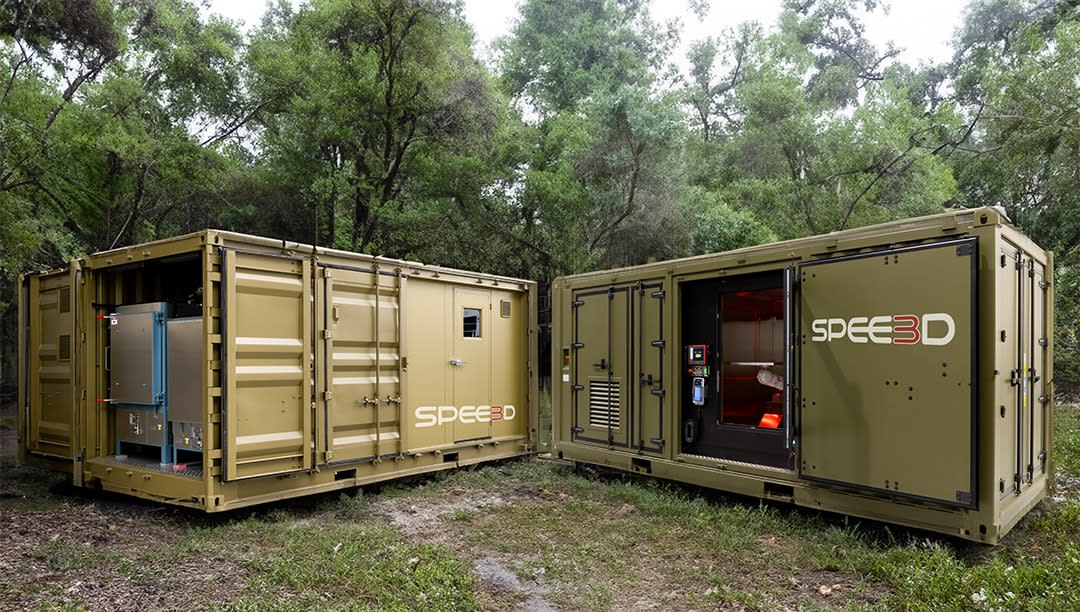
SPEE3D’s Expeditionary Manufacturing Unit (EMU), Source: SPEE3D
SPEE3D’s platforms have already been deployed across six defence forces globally, including the US, UK, Australia, UAE, Japan, and on active frontlines in Ukraine. Supported by a $270 million pipeline and forecast revenue of $94 million across FY27 – FY28.
The application of their technology extends beyond defence. The same constraints exist across industries such as mining, oil and gas, and utilities. The company is now positioned to scale into a $54 billion market, with defence alone representing a $20 billion opportunity.
Built on more than a decade of research and development, the technology is underpinned by a deep technical foundation. Supported by 20 patents across hardware, materials, and software. This combination creates a high barrier to entry and positions the company as the category leader.
One of the Most Compelling Opportunities We’ve Seen
SPEE3D was introduced to us last year through its largest shareholder, where we subsequently undertook an extensive due diligence process over several months. SPEE3D stands out as one of the most compelling growth opportunities we’ve identified in the past 18 months.
Unlike many opportunities, SPEE3D is already commercially validated, with proven deployments, growing revenue, and strong tailwinds, targeting a large and expanding market.
Founded by proven, award-winning engineers with a demonstrated track record of building and scaling successful businesses. SPEE3D’s technology is not easily replicated, reflecting over a decade of development and a robust patent portfolio.
SPEE3D commenced an ASX IPO process in late 2025, which was ultimately withdrawn due to an external market shock outside of the company’s control. Since that time, the investment case has continued to strengthen. Revenue has grown, the pipeline has expanded, and sentiment toward defence-aligned technologies has improved, further reinforcing the company’s positioning.
It presents a compelling entry opportunity at a valuation approximately half of that targeted during the IPO process.